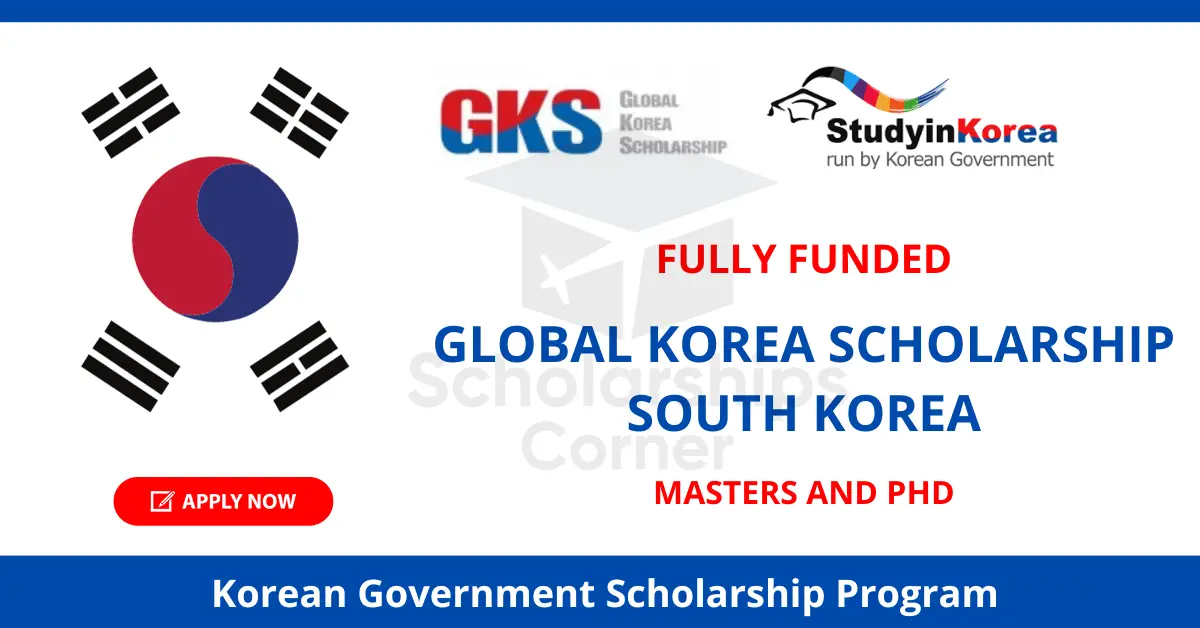
The prestigious and highly competitive Global Korea Scholarship 2026 is now open for applications. The GKS 2025 was previously known as the KGSP Korean Government Scholarship Program. This is a fully-funded scholarship, master’s, and Ph.D. degree program. This scholarship opportunity is sponsored by the Korean government. The KGSP 2026 will select more than 2000 international students from 155 countries who want to who wish to pursue a graduate-level degree (master’s or doctoral) or research in Korea. For detailed answers to frequently asked questions about the GKS program, check out our comprehensive FAQ guide here.
All selected students will be placed at different universities in South Korea. Korean Ministry of Education aims to increase international exchanges and competititeness. There are more than 104,000 international students who have been on this Korean scholarship since 2016. Fields are not limited, all candidates would get plenty of options to pursue their careers. There are two ways to apply for this KGSP 2024, either submitting their documents to the Korean Embassy of their country or directly to the domestic university of Korea.
This South Korean Scholarship (Global Korea Scholarship for Graduate Degrees) is one of the most prestigious and competitive scholarships in the world. It stands on par with other fully-funded international scholarship programs such as the US Fulbright Scholarship, Chinese Government Scholarship, Australia Awards Scholarships, Turkey Burslari Scholarships, Austria Government Scholarship, Brunei Darussalam Scholarship, Romania Government Scholarship, New Zealand Government Scholarship, Netherlands Government Scholarship Stipendium Hungricum Scholarship, and Daad Scholarship in Germany.
Why one should study in South Korea? South Korea provides well-structured scholarships, affordable living expenses, and low accommodation costs, making it an attractive destination for international students. The country offers a unique opportunity to build cross-cultural understanding, work in advanced laboratories, and experience the vibrant culture and modern cities. With its excellent academic standards and welcoming environment, South Korea is an ideal place for students seeking quality education and a global perspective
Host Country:
- South Korea
Course Level:
- Master’s Degree Programs
- PhD Programs
- Research Programs
Available Universities and Fields of Study:
- Refer to the 2026 GKS-G Available Universities & Fields of Study file attached in the Application Guidelines for general information. Contact each university for further information.
Two Main GKS Guides
- GKS Application Process Guide – FAQs– explains Embassy Track and University Track step by step.
- GKS Documents Required Guide – covers all required documents, apostille rules, and common mistakes
GKS Scholarship Duration:
-
Doctoral Degree Program: 4 years
- 1 year of the Korean language program
- 3 years of the regular degree program
-
Master’s Degree Program: 3 years
- 1 year of the Korean language program
- 2 years of a degree program
- Research Program: 6 Months or 1 Year
Benefits of the Korean Government Scholarship 2026:
The Global Korea Scholarship (GKS) is a fully funded program that covers almost all expenses for selected students. The scholarship includes:
- Round-trip Airfare (economy class ticket to and from Korea)
- Settlement Allowance (one-time payment upon arrival)
- Monthly Living Allowance
- 1-Year Korean Language Training Fees (fully covered)
- Full Tuition Fees for Degree Program
- Research Support Allowance (for eligible students)
- Medical Insurance Coverage
Check Joint Japan World Bank Scholarship 2026 | Fully Funded
Eligibility Criteria of Global Korea Scholarship 2026 in South Korea:
- All applicants must be international students. Korean citizens are not eligible to apply.
- Both the applicant and their parents must hold non-Korean citizenship.
- Applicants must be under 40 years of age at the time of application.
- Master’s program applicants must hold a Bachelor’s degree or an equivalent qualification.
- Doctoral program applicants must hold a Master’s degree or an equivalent qualification.
- Research program applicants must have received an official invitation from a participating Korean university before applying.
- Applicants who have previously received a GKS scholarship are not eligible to apply again.
- Applicants must be in good physical and mental health to complete the program successfully.
How to Apply for the Global Korea Scholarship 2026:
GKS Application Process (Embassy Track & University Track Explained)
Applying for the Global Korea Scholarship follows a two-stage selection process. Every applicant goes through two rounds of evaluation, no matter which track they choose. The main difference is where you apply first and who evaluates your application in the first round. Understanding this process early helps applicants avoid common mistakes and missed deadlines.
Note: Application steps may slightly vary by embassy or university. Applicants must always follow official instructions issued by the embassy, university, or NIIED.
Step 1: Choose the Correct Application Track
Before starting the application, applicants must choose one track only.
Embassy Track
- Apply through the Korean Embassy in your home country.
- You may apply to multiple universities within the allowed limit.
- This track is competitive but offers wider university choices.
University Track
- Apply directly to one Korean university only.
- You cannot apply to multiple universities.
- This track is suitable if you already contacted a professor or are targeting a specific university.
- Applicants cannot apply to both tracks at the same time.
Embassy Track: Complete Application Process
Step 2: Prepare and Upload Documents (First Round – Embassy)
In the Embassy Track, the first round is handled by the Korean Embassy.
What applicants must do:
- Fill out all required forms on the Study in Korea system.
- Upload scanned copies of all required documents.
- Upload one signed letter of recommendation (Form 5).
- Submit the complete application before the embassy deadline.
Important points:
- Apostille or consular confirmation is not required in the first round.
- All documents must be in English or Korean.
- Missing documents or signatures may result in rejection.
Step 3: Embassy Evaluation (First Round Selection)
The embassy evaluates applications based on:
- Academic background
- Personal statement and study plan
- Recommendation letter
- Overall quality and completeness of documents
After evaluation:
- The embassy selects a limited number of candidates.
- Only selected applicants move to the second round.
- Results are announced by the embassy.
Step 4: Submit Original Documents to NIIED (Second Round)
If selected by the embassy:
- Applicants must submit one full set of original documents to NIIED.
- Required certificates must be apostilled or consular confirmed.
- The original recommendation letter must be included.
Important:
- Apostille is required only at this stage, not earlier.
- Documents submitted to NIIED are not returned.
Step 5: NIIED Evaluation and Final University Matching
NIIED reviews:
- Applicant eligibility
- Authenticity of documents
- Overall application quality
For Embassy Track applicants:
- NIIED forwards applications to Korean universities.
- Universities review applications and decide admission.
- Final results are announced by NIIED.
University Track: Complete Application Process
Step 2: Apply Directly to a University (First Round)
In the University Track, the first round is handled by the university.
What applicants must do:
- Apply directly to one Korean university only.
- Follow the document submission rules set by the university.
- Submit required forms, certificates, and one recommendation letter.
Important:
- Some universities accept electronic files.
- Some may request additional documents, such as a portfolio or proposal.
- Apostille is usually not required in the first round.
Step 3: University Evaluation (First Round Selection)
The university evaluates:
- Academic record
- Study plan or research proposal
- Recommendation letter
- Program suitability
After evaluation:
- Selected applicants are nominated to NIIED.
- Unselected applicants exit the process.
Step 4: Submit Documents to NIIED (Second Round)
If nominated by the university:
- Submit one set of original documents to NIIED.
- Required certificates must be apostilled or consular confirmed.
- Documents must be in English or Korean.
- Failure to submit correct documents at this stage results in disqualification.
Step 5: Final Approval by NIIED
NIIED conducts the final review:
- Confirms eligibility
- Verifies submitted documents
- Approves final scholarship recipients
- Final results are announced by NIIED.
Important Rules All Applicants Must RememberL
- Apply through only one track (Embassy or University).
- Apostille is required after selection, not before.
- Missing documents or signatures can cancel the application.
- Embassies and universities may add small requirements.
- Deadlines are strict, and extensions are not guaranteed.
Required Documents for GKS South Korea Scholarship 2026:
- Recommendation letters
- Attested transcripts
- Statement of Purpose
- Awards
- Published books
- Certificate of Proficiency
- Medical Assessment form
Application Deadline:
- Every country’s Korean embassy and the domestic university have different deadlines, so hurry up and apply as soon as possible.